
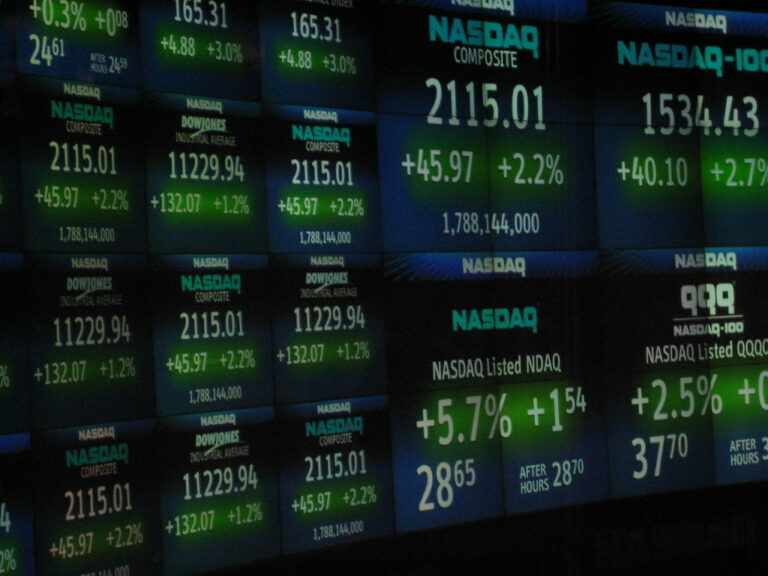
We are living through a strange contradiction. On one side, the headlines are grim: wars in Ukraine and Gaza, rising living costs, families struggling to pay their bills, and millions of people feeling economically insecure. On the other side, financial markets keep celebrating. They break records, accumulate wealth, and behave as if the world is enjoying a golden age.
This is what we might call the capitalism paradox: two economies, one world. The stock market is soaring while the real economy — the one most people actually live in — is under pressure.
On 9 February 2024, the S&P 500 closed above 5,000 points for the first time in its history, even as wars raged in Ukraine and Gaza. That was not the end of the story. In 2024, the index rose by more than 23%. In 2025, it gained nearly 16% more. And in 2026, it continued climbing, reaching historic highs above 7,800 points in October. The question is simple: how can both things be true at the same time?
Why the stock market is not the real economy
The short answer is that the stock market is not the economy most people live in. Share prices reflect expectations about future corporate profits. Those profits can rise even when wages stagnate, when prices go up, or when demand for weapons, energy and security grows because of conflict.
The S&P 500 is not a mirror of the country’s economic health. It is a very exclusive club of 500 large companies, many of which earn a significant share of their revenue abroad — nearly 30% overall, and around 55% for technology companies. Their profits depend on global factors, technology, and their ability to protect margins, not necessarily on whether your neighbour can afford groceries.
Since 2000, S&P 500 earnings per share have risen by more than 350%, and the index’s total return has increased by around 630%. Over the same period, nominal GDP grew by only about 200%. The average American company grew by just 47%. The gap is enormous.
As J.P. Morgan Private Bank has put it, markets follow profits, while the real economy is driven by wages and consumption. Wages have struggled to keep pace with profits. That is why the S&P 500 can soar while ordinary people feel squeezed.
The great divergence: Wall Street versus Main Street
This disconnect between finance and daily life has a name: the K-shaped divergence. On one side, asset owners see their wealth grow as markets rise. On the other, people who live on salaries face higher bills, persistent inflation and a growing sense of economic insecurity.
For those who own assets, crises can become opportunities. For those who live on a salary, the same crises mean higher costs and fewer certainties. And this gap does not stay still. Over time, it widens, and wealth accumulates in fewer and fewer hands.
The numbers are stark. According to an Oxfam report published in January 2026, the richest 1% of the world’s population now owns 43.8% of total global wealth. The poorest half of humanity owns just 0.52%. On average, a person in the richest 1% owns 8,251 times more wealth than a person in the poorest half.
More troubling still, economic concentration increasingly translates into political concentration. Oxfam notes that in 136 countries, the data confirms that the more unequally economic resources are distributed, the more unequally political power is distributed too. Policy decisions tend to reflect the preferences of high-income groups rather than those of ordinary citizens. The paradox is therefore not only economic; it is deeply political.
War as a profit engine
One of the darkest sides of this paradox is the way armed conflict feeds the profits of certain industries. The defence economy does not seem to know a downturn.
According to the Stockholm International Peace Research Institute (SIPRI), sales by the world’s 100 largest arms companies reached a record $679 billion in 2024, up 5.9% from the previous year. The increase is directly linked to demand generated by the wars in Ukraine and Gaza.
US companies dominate this market. The 39 US firms in the top 100 generated $334 billion in revenue in 2024 — nearly half the global total. European companies, boosted by the war in Ukraine and the perception of a Russian threat, saw their combined revenues jump by 13% to $151 billion.
For investors holding shares in these companies, war means returns. For the populations living through those conflicts, it means destruction and grief. The same global event produces radically opposite effects depending on where you stand in the economy.
Pension funds: savings and unintentional complicity
You might assume that pension funds, which manage the retirement savings of millions of workers, are neutral or virtuous actors. The reality is more complicated.
A Carbon Policy Initiative (CPI) analysis published in January 2026 examined 594 pension funds across OECD countries, representing $22.5 trillion in assets under management. The verdict was clear: **these funds invested $169 billion in companies expanding fossil fuel operations in 2025**. That represents 55% of the $310 billion invested in the energy sector.
More than half of these funds have made no public commitment to low-carbon sectors or to excluding fossil fuel investments. Yet some countries, such as Denmark, the Netherlands and the United Kingdom, which have introduced clear regulations, show more ambitious environmental targets.
This means that the retirement savings of millions of workers are helping — often unknowingly — to finance industries that drive global warming and, sometimes, companies linked to arms production. This is not about individual malice. It is about systemic structures that make it difficult to align savings with values.
What can we do about the capitalism paradox?
Each of us is part of this machine — as a consumer, a worker and often an investor. That also means each of us has some leverage.
1. Find out where your money is invested
The first step is to know where your money goes. If you have a pension fund or employee savings plan, ask about your manager’s investment policies. Request options that exclude weapons or fossil fuel expansion if those criteria matter to you. Some funds offer “ESG” mandates — environmental, social and governance — but you need to check what they actually cover.
2. Consume more consciously
It is hard to be perfect, but every purchase is a vote. When possible, favour companies that pay fair wages and are transparent about their supply chains. Reduce your overall consumption. Be aware that there is no such thing as perfect consumption in an imperfect system, but small choices can send signals to companies.
3. Support policies that tackle inequality
The capitalism paradox is not a law of nature. It is the result of political choices. Support policies and representatives who genuinely address inequality — through taxation, financial regulation or social policy — instead of ignoring it or downplaying it.
Conclusion: a stock market record is not good news by itself
A record on Wall Street is not, by itself, good or bad news. It becomes a problem when it is the only number we look at to judge the health of our society.
A better world will not be measured by the level of the S&P 500, but by other indicators: how many people can live with dignity, how much nature we leave to the next generation, and how much peace we manage to build. The capitalism paradox will not disappear by closing our eyes to markets, but by putting them back in their place: as one tool among many, serving goals that go beyond the simple accumulation of profits.
Check those articles