
Alongside the music, Stefano Tucci writes guitar method books in English, published on Kindle. All three titles share the same approach: every note is explained by what it does harmonically, never by ear alone, and every chapter follows the same structure so you always know where you are.
All three include seven-string extensions, so they work whether you play six or seven strings. Tabs print the seventh string in grey: six-string players simply ignore it.
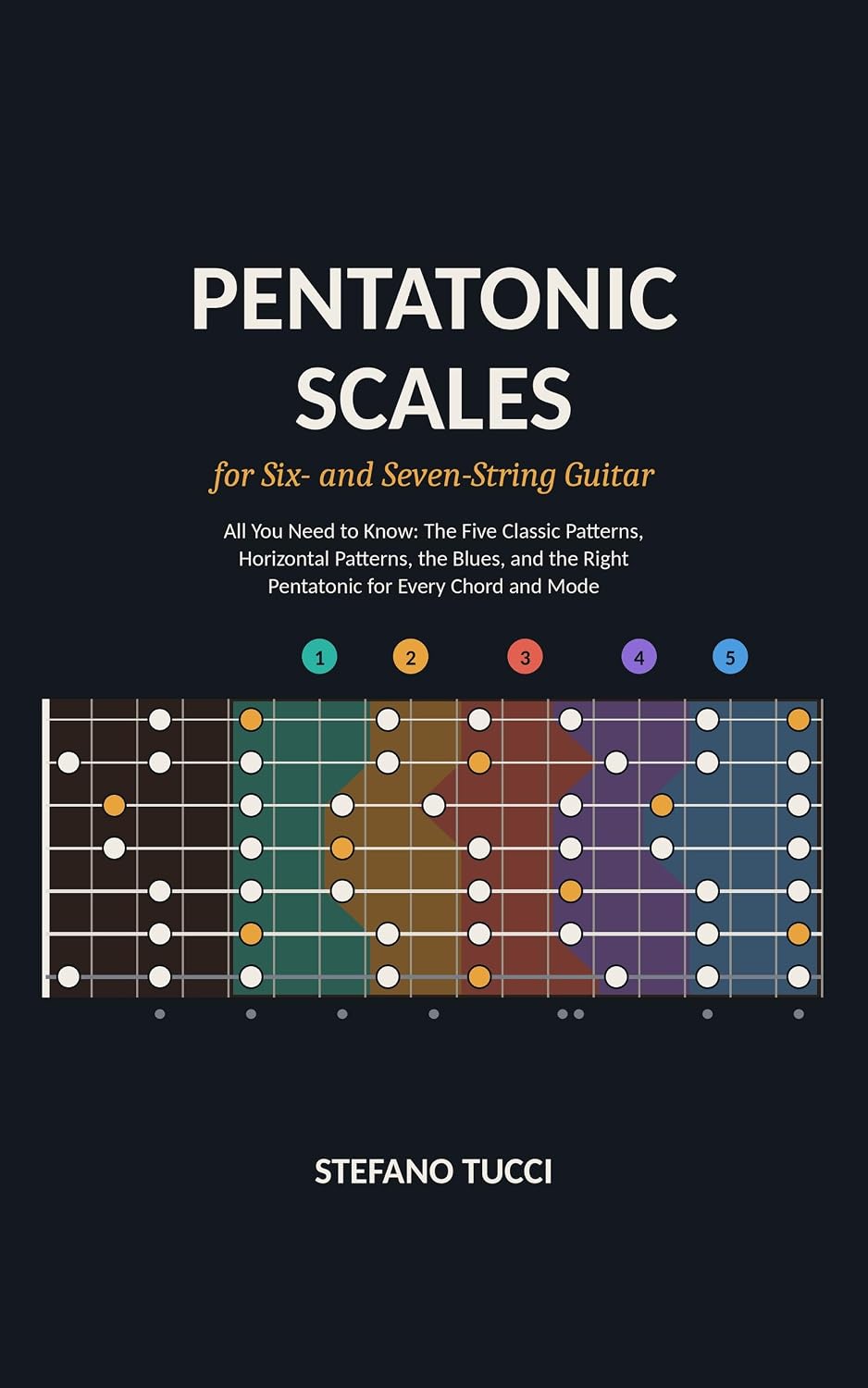
Pentatonic Scales for Six and Seven-String Guitar
All You Need to Know: The Five Classic Patterns, Horizontal Patterns, the Blues, and the Right Pentatonic for Every Chord and Mode.
Published 25 October 2026 · 329 pages
Stop playing boxes, start playing functions. You know box 1 of the minor pentatonic and you can play it fast, but you cannot say what a note is doing against the chord, or why the same lick sounds right over one chord and wrong over the next.
Every note in every figure is labelled — root, 3rd, 5th, 7th or tension — against the chord sounding under it. Every exercise is written in standard notation and tablature, with a starting and a target tempo, and no audio is needed: each one gives its chords and tempo to record in a looper or a DAW.
- The patterns: the five classic shapes of the minor and major pentatonic, every note labelled.
- Horizontal playing: one string, two-string lanes, three notes per string, octave shapes, connecting boxes mid-phrase, bends to target pitches and the blues scale.
- Choosing the right one: which pentatonic over which chord and why several work, following a progression without moving your hand, and a pentatonic for each of the seven modes, the V7 in a minor key and the altered dominant.
From Reproducing to Creating on Electric Guitar
A Method for the Intermediate Player – Technique and Applied Theory, with Seven-String Extensions.
Published 18 October 2026 · 139 pages
You can play solos you have memorised, but you cannot say why a note works, and you freeze when the chords change. Every note here is justified by its harmonic function — root, 3rd, 7th, tension or passing note — never by “it just sounds good”.
Each chapter follows the same template: the problem, the minimum theory, the fretboard map, exercises with a starting and a target tempo, an original application over a chord progression, and a self-assessment checklist.
- Part 1 — Technique: alternate and economy picking, legato, muting with both hands, bends in tune, slides and position shifts, string skipping, timing on the offbeat.
- Part 2 — Applied theory: intervals, triads and seventh chords, harmonising the major and minor scales, chord tones versus passing notes, cadences.
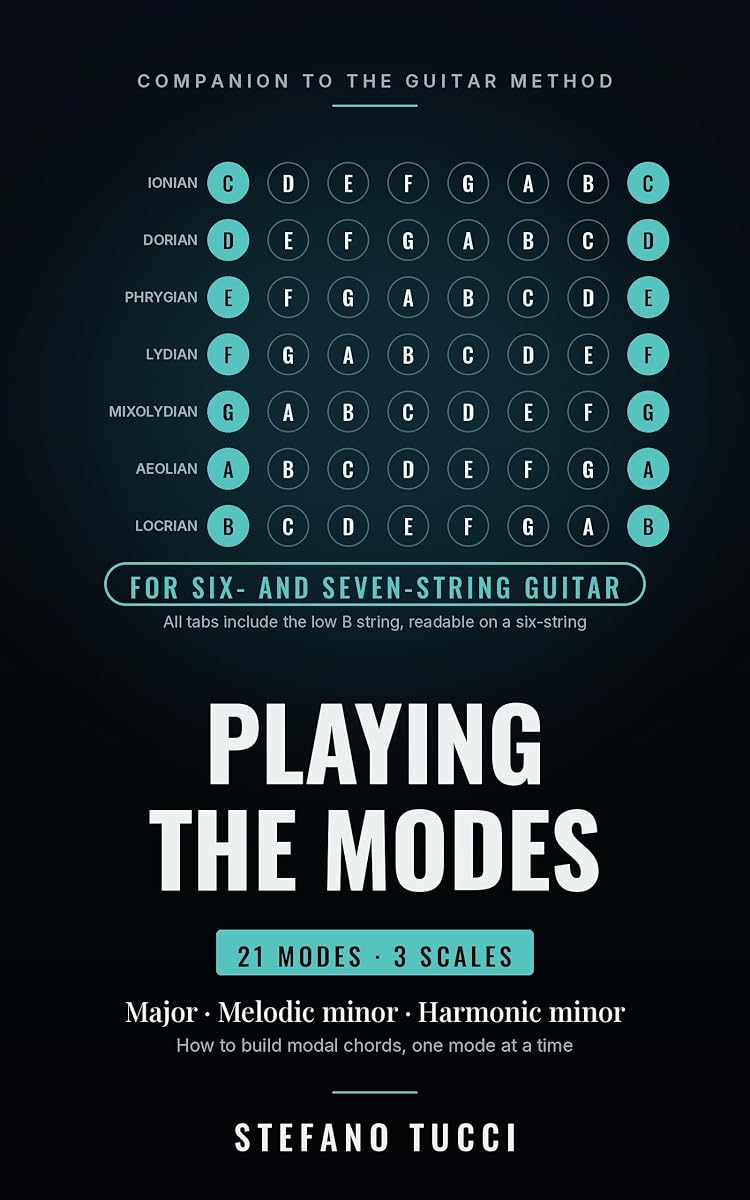
Playing the Modes for Six and Seven-String Guitar
How to Build Modal Chords – 21 Modes of the Major, Melodic Minor and Harmonic Minor Scales, with 7-String Guitar Tabs.
Published 12 October 2026 · 147 pages
A mode is not a new scale to memorise. It is a parent scale with a different note treated as home, and it only exists while a chord holds that home note in place. The book teaches the modes that way: one at a time, through its characteristic note and the chords it produces.
Each of the 21 chapters is built the same way: the mode set against the plain major or minor it resembles, so you hear the single note that changes; the mode harmonised on all seven degrees with a chord diagram for each; a vamp that fixes the home note; and the scale in a fretboard box you already know, with an original lick and a seven-string extension.
- Part 1: the seven modes of the major scale, Ionian to Locrian.
- Part 2: the modes of the melodic minor, including Lydian dominant and the altered scale.
- Part 3: the modes of the harmonic minor, including Phrygian dominant.
Questions about the books
For questions, teaching enquiries or review copies, get in touch. You can also hear the playing behind the method in the discography.